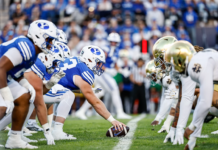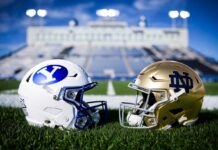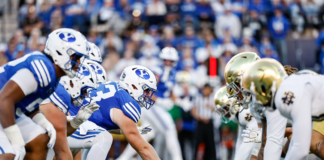

The BYU-Notre Dame game has been circled on the calendar ever since the two programs were supposed to meet in the Pop Tarts Bowl last year after both were snubbed and left out of the College Football Playoff.
However, with the Irish declining a bowl invite, the matchup with the Cougars never happened in what would have been an epic game. Thankfully the football gods have given us another opportunity to watch these two great programs go head-to-head in a primetime matchup on national television.
Both teams had favorable schedules through the first half of the season, but thankfully with a number of upsets to start the season, it opened the door for a Top 10 showdown in Provo.
Because that’s just what college football is: a beauty pageant.
Perception matters, rankings matter, and your conference affiliation matters. And when the College Football Playoff selection committee eventually sorts through a crowded field, the quality of a team’s résumé — including its strength of schedule — becomes critical. And let’s be honest… it never hurts to have the right logo stitched on your jersey too.
Yes, the AP Poll doesn’t determine the CFP field, but it shapes the narrative such as strength of schedule, strength of conference, which are some of the most-looked at metrics every year. Having more Top 10 and Top 25 wins helps elevate programs and resumes, and the AP voters are the ones that determine that… unfortunately.
Support the channel by subscribing to our free newsletter. Get lots of unique content that you won’t find anywhere else.
Where Notre Dame Affiliated AP Voters Rank BYU
Two AP voters with Notre Dame ties have suddenly become consistently bullish on BYU after taking dramatically different views of the Cougars over the previous two seasons.
And they’re been doing it all year before BYU hosts Notre Dame. Is that a coincidence? It feels like it.
Let’s look at the patterns.
The two AP voters who are affiliated with Notre Dame are Eric Hansen, a longtime Notre Dame beat writer, and Dylan Sinn, who also covers the Irish. Looking at their BYU ballots over the past three seasons reveals something that is easy to miss when looking only at the current AP rankings.
They haven’t always agreed on BYU. In fact, they essentially flip-flopped.
In 2024, Hansen was generally bullish on BYU, while Sinn was generally bearish. Hansen ranked the Cougars above the AP consensus in seven of the 12 polls, while Sinn ranked them below consensus in seven of those polls.
Then 2025 brought a reversal.
Hansen became significantly more skeptical of BYU, ranking the Cougars below the AP consensus throughout the season. Sinn moved in the opposite direction, ranking BYU above the consensus the last half of the season.
So the two voters spent the previous two seasons showing different opinions about BYU.
No. 8 BYU Defeats No. 2 Notre Dame — Here’s All The Reactions
Then came this year.
Suddenly, magically, they’re on the same page.
Through the preseason and first four regular-season AP polls, both Hansen and Sinn ranked BYU higher than the AP consensus every single time.
That’s not a one-week anomaly.
Hansen opened the year with BYU at No. 10, four spots ahead of the AP’s No. 14 ranking. In Week 1, he had BYU at No. 11 while the Cougars were No. 15 nationally. He had them No. 10 in Week 2 and No. 8 in Week 3 where they’ve stayed.
Sinn has been even more aggressive.
He ranked BYU No. 11 in the preseason, No. 11 in Week 1, No. 9 in Week 2 and No. 7 in Week 3. This week, he has the Cougars at No. 6 — two spots ahead of their actual ranking.
Meanwhile, the AP consensus went No. 14, No. 15, No. 11 No. 9 and eventually No. 8 where the Cougars have been the past few weeks.
Put simply, both voters have been ahead of the market on BYU all season. Coincidence? I think not. But let’s keep digging in. If one Notre Dame-connected voter consistently ranked BYU higher, that would be interesting.
If it happened for one or two weeks, it could easily be dismissed.
But both voters have done it in every 2026 poll — after spending the previous two seasons taking very different positions on the Cougars.
Why The Timing Matters
With both teams getting snubbed last year in the College Football Playoff, both programs have a lot at stake as a win on Saturday, more than likely gets them in this time.
Both programs operate outside the SEC and Big Ten, the two conferences that control all the power in the sport. With Notre Dame operating as an independent, something BYU did for more than a decade before landing in the Big 12 — both schools know what’s on the line come Saturday… and they both need each other.
The higher the ranking, the better the resume.
No. 8 BYU Defeats No. 2 Notre Dame — Here’s All The Reactions
Is BYU Getting Special Treatment?
At this point, yes, for the most part… and the data proves it.
Hansen and Sinn have both ranking BYU at or above the AP consensus in every 2026 poll. And the difference has sometimes been substantial with BYU being 4-5 spots higher than consensus.
And the fact that their opinions didn’t simply become more bullish. They converged.
In 2024, Hansen was bullish and Sinn was bearish.
In 2025, Hansen was bearish and Sinn was bullish.
In 2026, they’re both bullish.
And they’re both bullish in the exact moment that BYU is playing Notre Dame in a game that will have major College Football Playoff implications. That’s more than enough to raise an eyebrow.
On the other hand, maybe Hansen and Sinn simply believe BYU is better than what other AP voters think. Maybe their evaluation of BYU’s roster this year and going 23-4 over the past two seasons (2024, 2025) has given them more confidence in the Cougars. That’s entirely possible.
Is This Big 12 Getting Special Treatment?
There’s another piece of the puzzle that makes the voting data even more interesting.
Sinn’s bullishness on BYU isn’t happening in isolation. He’s been aggressively bullish on the Big 12 throughout the 2026 season. In Week 2, he ranked Houston nine spots above the AP consensus and finished with an average Big 12 placement 2.75 spots above the national ranking. In his latest poll, he has 4 Big 12 teams in the Top 12:
No. 6 BYU
No. 8 Utah
No. 11 Oklahoma State
No. 12 Texas Tech
No. 17 Houston
This provides a reasonable explanation as to why Sinn has BYU ranked as high as he does as he done so for all the Big 12 programs. He doesn’t seem to be inflating BYU at all, as all the Big 12 schools are benefiting this year.
Hansen’s votes haven’t been as bullish. In the latest poll, Hansen has:
No. 8 BYU (At consensus)
No. 11 Texas Tech (1 spot below consensus)
No. 14 Utah (3 spots below consensus)
No. 17 Oklahoma State (1 spot above consensus)
Houston (NR)
Of the 63 voters in the AP Top 25 poll, Hanses is one of only 3 voters who didn’t rank Houston. With Texas Tech and Utah below consensus as well, it’s safe to say that Hansen isn’t bullish on the Big 12.
So while Sinn appears to have a broader Big 12 thesis, Hansen’s 2026 ballot looks more selective.
And that brings us back to the original question.
In my opinion, Hansen seems to be boosting the Cougars ahead of the Top-10 showdown, while Sinn is just bullish on the Big 12 altogether.
After these two teams play Saturday, it will be interesting to see how Hansen and Sinn rank BYU the rest of the way.
Follow Justin Giles on Twitter and Fan Insider on Facebook.
If you enjoyed this article, subscribe to my newsletter. It’s FREE!
No. 8 BYU Defeats No. 2 Notre Dame — Here’s All The Reactions